Prince Paija Magar
I design it, build it, connect it and secure it.
Networks first, then the people who attack them.
I am a cybersecurity professional based in Kathmandu, focused on email security, threat detection and network defence. My work combines secure system design with hands-on offensive testing, with the aim of stopping attacks before they reach users.
My experience is grounded in building production-style systems. I designed and developed Genjutsu, a nine-layer phishing detection and honeypot platform for Gmail, Outlook and IMAP mailboxes, running on Render and Cloudflare, and have built applied projects in AI, IoT and web development. I am proficient with industry tools including Nmap, Wireshark, Burp Suite and Metasploit, and hold four AWS Academy certifications, including Cloud Security Foundations, along with RCNA Routing & Switching and WLAN.
I am currently pursuing an MBA in International Business and Project Management to complement my technical background. My goal is to contribute to a security operations team, and in the longer term to build security products and capability for organisations in Nepal.
Genjutsu
An AI-powered phishing detection and honeypot system for Gmail, Outlook and any IMAP mailbox. It scans every incoming email through nine layers of checks, flags dangerous messages in real time, and replies to scammers with an AI decoy that draws out their intent.
- Gmail API & Microsoft Graph (OAuth 2.0), IMAP
- SPF / DKIM / DMARC
- Naive Bayes classifier
- NLP signals
- Google Safe Browsing
- URL & QR code scanning
- Attachment content scanning
- Shared threat feed
- “Nami” AI honeypot
- Telegram alerts
Detect
Every incoming mail is checked for spoofed senders, poisoned links, hidden QR codes, risky attachments and scam language, then scored.
Deceive
Nami, a GPT-OSS-120B persona on Groq, replies to scammers and wastes their time while the system learns from them.
Govern
A three-role admin portal with organization dashboards and PDF reports, running on Render, Cloudflare Workers and PostgreSQL.
Inside Genjutsu
How a suspicious email moves through the system, what testing showed, and how the results reach a SOC.
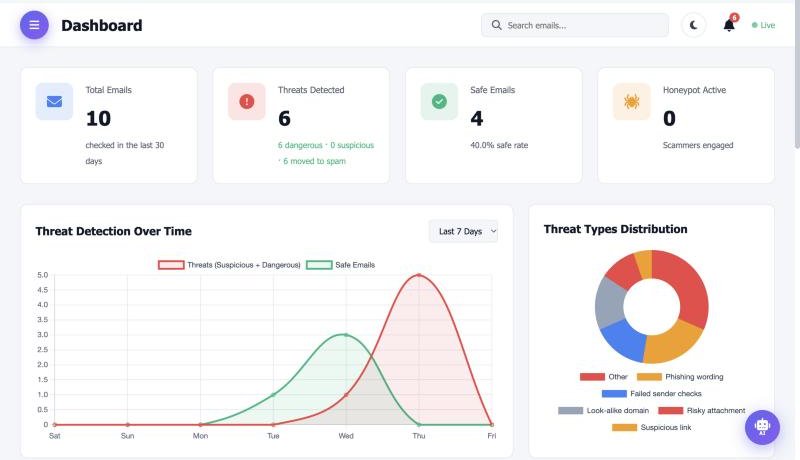
The pipeline
- Sender: SPF, DKIM and DMARC parsed from the real headers, plus look-alike domain checks.
- Content: phishing and urgency wording, NLP signals and a Naive Bayes classifier trained on scam and safe mail.
- Links: pattern checks and Google Safe Browsing, including links hidden in QR codes.
- Attachments: double extensions, risky file types and what is hidden inside the files.
- Shared intelligence: a global block list and a threat feed of attackers seen across Genjutsu users.
The final score decides what happens next: move to spam, alert on Telegram, or hand the sender to Nami.
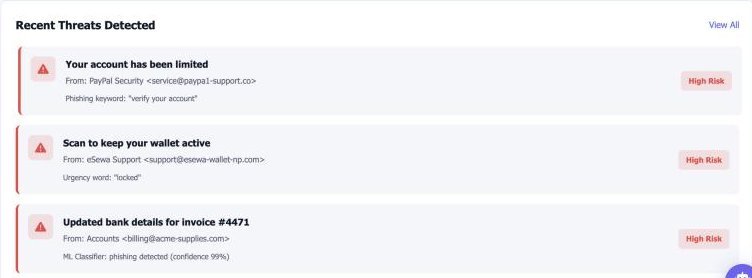
Results
Built for the SOC
Every detection exports straight into a SIEM: JSON lines for Splunk, Elastic or Wazuh, ArcSight CEF, or RFC 5424 syslog, tagged with MITRE ATT&CK techniques and indicators of compromise.
CEF:0|Genjutsu|Email Security|3.1|EMAIL-DANGEROUS|Dangerous email detected|9|
[email protected] msg=Your account has been limited
cs1Label=mitre cs1=T1566.002
cs2Label=reasons cs2=SPF: FAIL for paypa1-support.co; Lookalike domain of paypal.com; Phishing keyword: "verify your account"
cs3Label=iocDomains cs3=paypa1-support.co request=https://paypa1-support.co/verify
cn1Label=score cn1=94
A CEF event from Genjutsu's exporter for the demo PayPal look-alike, wrapped for reading.
Case study: phish_lab
A credential-harvesting attack I built from scratch for my Ethical Hacking coursework, run end to end, then turned around to show how defenders catch it.
The attack chain
- Recon: the target and their email address were found through open-source intelligence.
- Weaponise: Flask and Jinja2 clones of the Instagram, Facebook and Snapchat login pages, served over HTTPS through ngrok and hidden behind a shortened link.
- Deliver: a "suspicious login" warning sent with the Social-Engineer Toolkit, posing as Instagram Security.
- Exploit: a double-capture trick rejects the first password, so the victim types it twice. Both appear live on the attacker's dashboard.
- Take over: the stolen credentials log in and change the password, locking the owner out with no malware at all.
How a SOC catches it
- At the mail gateway: a "security alert" whose sender fails DMARC for the brand it claims, carrying a shortened link to a tunnelling domain.
- In identity logs: a sign-in from a new IP and device, followed within minutes by a password change, is a classic takeover pattern.
- With users: a login page that rejects a correct password once and then accepts it is a tell people can be trained to notice.
The full write-up also covers the legal side under Nepal's Electronic Transactions Act 2063. Genjutsu was built to stop exactly this kind of email.
Other things I've built
Nami
Ollama, Llama 3.1 8B, ChromaDBA private, bilingual Nepali–English voice assistant running fully on my MacBook, with long-term memory and an iPhone client over Tailscale.
Penetration test simulation
Metasploit, Kali LinuxHid a Meterpreter payload inside an image, delivered it through a simulated phishing email, then monitored, exfiltrated test data and covered tracks, before investigating the same attack from the victim's side.
phish_lab
Python, FlaskA custom phishing simulation framework built for my ethical hacking module, to show how campaigns are run and caught.
Mero Sathi
Firebase, Leaflet, WebRTCA progressive web app for couples across Kathmandu Valley, with live maps, calling and an admin dashboard.
AI desk companion
ESP32, Groq, ElevenLabsA small robot that talks back, with an OLED face, servo movement and its own battery.
Rain Safe Hanger
ESP8266, rain sensorAn IoT system that detects rain in real time and rotates outdoor clothes hangers under cover, with a Telegram alert.
Printer e-commerce site
HTML, CSS, JavaScriptA seven-page online store for printers with interactive shopping features and dynamic content.
Knight's Table
WebA chess web app for playing in the browser.
Education
MBA
Specialising in International Business Management and Project Management.
BSc (Hons) Computer Networking & IT Security
First Class Honours. Islington College, Kathmandu, awarded by London Metropolitan University.
+2 Science
Gorkha International Public Secondary School, National Examination Board.
Experience
Robo Tutor, ING Skill Academy
Taught robotics and electronics to Grade 1–9 students across partner schools in Kathmandu, guiding block-based and Python/C++ programming on Arduino and ESP32.
Networking Assistant Intern, Network Store Pvt. Ltd.
Set up, configured and maintained routers, switches and access points, and diagnosed LAN/WAN connectivity issues alongside senior engineers.
Toolkit
Security
Security tools
Networking
Build
Certifications
Let's make something harder to break.
Open to SOC, SIEM and security engineering roles, and to people building things for Nepal.
- [email protected]
- Phone
- +977 9869028993
- Location
- Kathmandu, Nepal